Article originally published in AFRC News by Micah Garbarino
and in the Hill Air Force Base
link: https://www.hill.af.mil/About-Us/Fact-Sheets/Display/Article/1464092/388th-fighter-wing/
HILL AIR FORCE BASE, Utah (AFNS) —
The “Rude Rams” of the 388th Fighter Wing’s 34th Fighter Squadron have won the 2025 Raytheon Award, which recognizes the top fighter squadron in the United States Air Force.
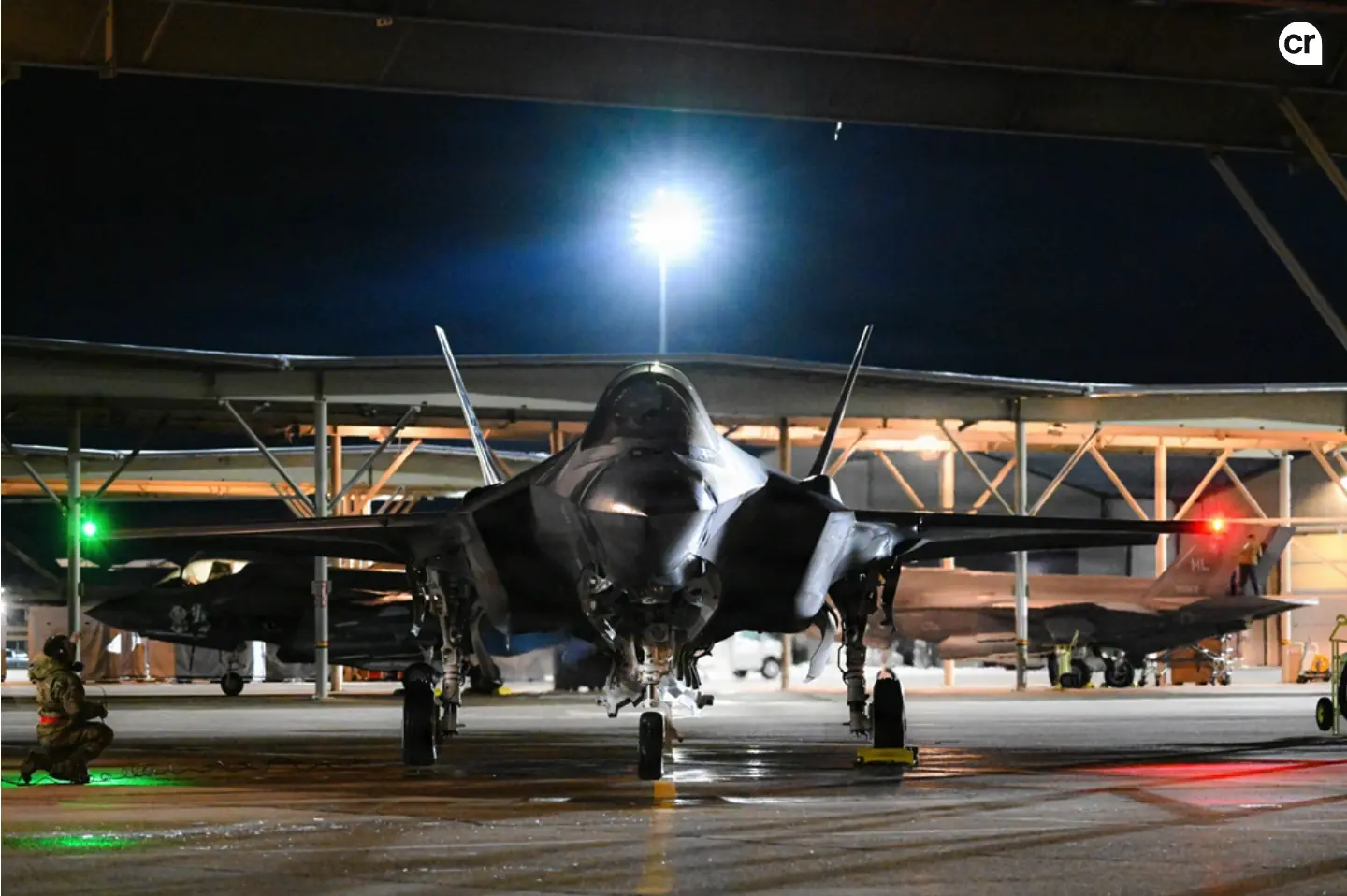
It was a busy year in 2025, which saw the 34th FS and 34th Fighter Generation Squadron deploy the F-35A Lightning II in support of combat and contingency operations in the U.S. Central Command and U.S. Indo-Pacific Command areas of responsibility.
“This award recognizes more than just capability – it recognizes a warrior mindset,” said Gen. Adrian Spain, commander of Air Combat Command. “The Airmen of the 34th have demonstrated an unwavering resolve to take the fight to the enemy, generating lethal effects under the most demanding conditions. That is the essence of readiness – not just being ready to deploy but being ready to win.”
The squadron was deployed 11 out of 12 months, flew thousands of combat hours, and contributed significantly to two historic operations in CENTCOM: Rough Rider and Midnight Hammer.
Operation Rough Rider’s objective was to disintegrate the capabilities of the Houthi terrorist organization in Yemen. During the operation, pilots from the 34th FS contributed to strikes that destroyed air defense systems, command-and-control facilities, weapons storage facilities, surface-to-air missile and ballistic missile capabilities. They also recorded the first air-to-air kills from an F-35A against one-way attack drones.
“The 34th FS has set a standard for fighter squadrons,” said Col. Charles Fallon, 388th FW commander. “Their achievements in combat and their dedication to advancing F-35A warfighting capabilities are a testament to the professionalism of our Airmen.”
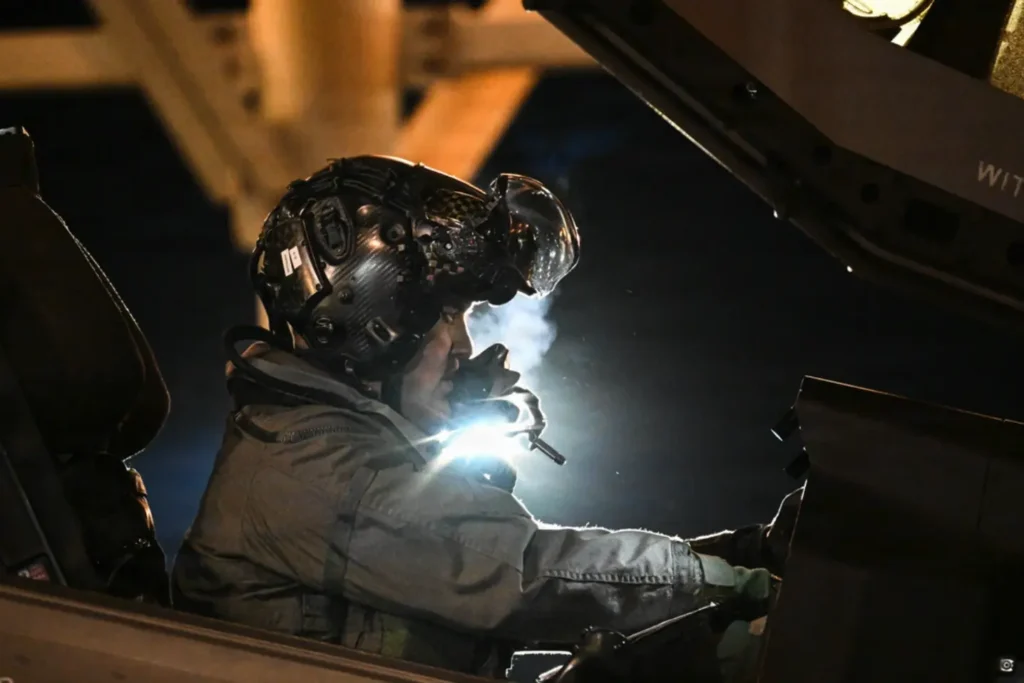
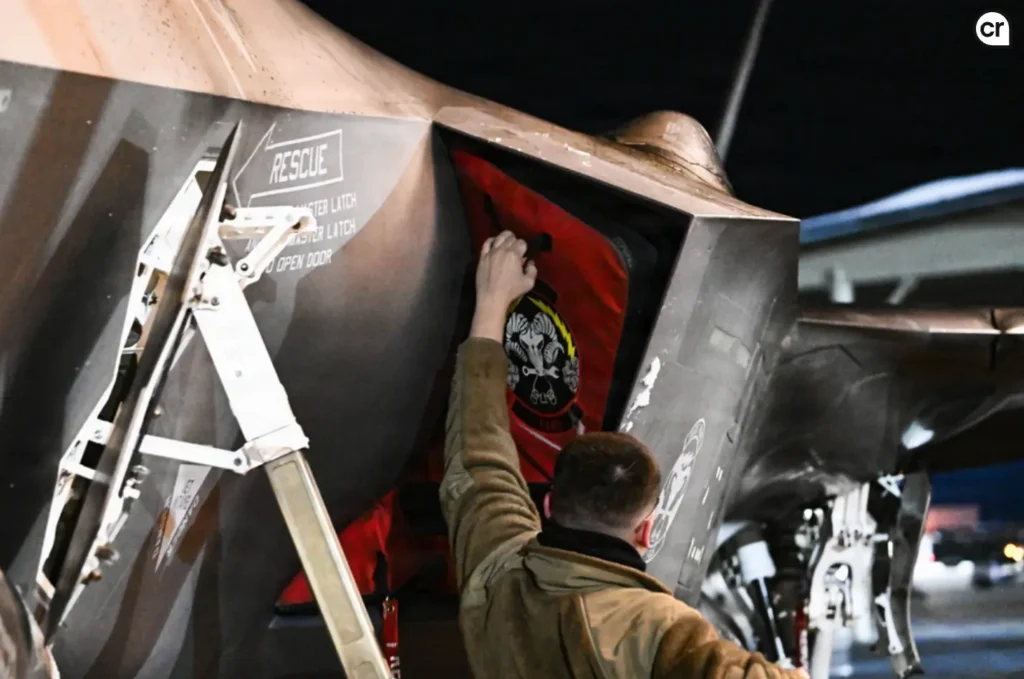
On June 22, 2025, the 34th was called upon to escort a strike package, including B-2 Spirit bombers, into Iran’s contested airspace to strike underground nuclear sites at Fordo, Natanz and Isfahan, during Operation Midnight Hammer.
A formation of F-35s flown by 34th FS pilots were the first aircraft to penetrate Iranian airspace, suppressing enemy air defenses and escorting the B-2s to their target areas. The operation called for precise timing and fearless flying from the fourth and fifth generation fighter aircraft that were part of the strike package.
“To see the squadron grow and get to a spot where the Airmen are comfortable living and working in a place where they’re being shot at and still be experts … it was impressive to see,” said Lt. Col. Aaron Osborne, 34th FS commander. “It was the maintainers in the 34th FGS, that we deploy side-by-side with, that made all these sorties possible.”
The squadron also supported U.S. naval forces, providing defensive air cover for multiple carrier strike groups transiting through maritime chokepoints in CENTCOM.
During a previous deployment to U.S. Indo-Pacific Command, also in 2025, the squadron executed dozens of alert scrambles to counter aggression and reinforce U.S. commitments to stability. In addition to overseas deployments, the squadron supported homeland defense by flying several sorties in support of the President of the United States and Operation Noble Eagle.
The 34th FS was the first combat-coded F-35A squadron in the U.S. Air Force and is the most decorated F-35 unit in history – earning a Galant Unit Citation for its actions in CENTCOM. Airmen received dozens of nominations and awards for heroism and combat achievement, including nominations for the Silver Star, Distinguished Flying Cross and Bronze Star.
About the 388th Fighter Wing
The primary mission of the 388th Fighter Wing at Hill Air Force Base, Utah, is to maintain combat readiness to deploy, employ, and sustain F-35A Lightning II aircraft worldwide in support of the national defense. The 388th FW is assigned to Air Combat Command, Joint Base Langley-Eustis, Virginia, and below that, Fifteenth Air Force, Shaw Air Force Base, S.C. ACC’s mission is to provide the world’s best combat air forces, delivering rapid, decisive air power, anytime, anywhere.
The 388th Bombardment Group (Heavy) activated at Gowen Field, Idaho on Dec. 24, 1942, and relocated to the Royal Air Force Base at Knettishall, England between June 1943 and the end of World War II. Equipped with B-17 bombers, the group flew 306 missions over Europe, and received two distinguished unit citations. It attacked German ball-bearing and aircraft production, naval yards, and synthetic oil plants, and supported the Allied landings at Normandy. At the end of the war the group dropped food and supplies over Northern Europe, after which it inactivated at the end of August 1945.
On March 23, 1953, the 388th Fighter Day Wing was established, but not equipped, at Clovis AFB, New Mexico. It was redesignated the 388th Fighter-Bomber Wing on November 5 of that year, and then activated on November 23. Simultaneously, the 388th BG(H) activated and was redesignated the 388th Fighter-Bomber Group. It formed the operational core of this new wing, equipped with F-86 Sabres, and later, F-100 Super Sabres. The 388th relocated to Etain-Rouvres Air Base, France in late 1954, where it remained until 1957, when it inactivated.
The wing again activated on May 1, 1962 at McConnell AFB, Kansas and was redesignated the 388th Tactical Fighter Wing. Trained on the F-105 Thunderchief, the wing inactivated again in February 1964, but was quickly reorganized and activated again on 14 March 1966, stationed at Korat Royal Thai Air Force Base, Thailand. Flying first the F-105, and then the F-4 Phantom II, the wing flew more than 60,000 hours over Laos, Cambodia, and North Vietnam from 1966-1973. It continued to support U.S. operations in Southeast Asia after the ceasefire with North Vietnam, and participated in the recovery of the S.S. Mayaguez in May 1975. The wing departed from Korat RTAFB in December 1975, taking with it a Presidential Unit Citation, eight Air Force Outstanding Unit Awards with combat valor devices, and the Republic of Vietnam Gallantry Cross with Palm.
Restationed at Hill AFB, Utah, the 388th TFW continued to fly the F-4, but in April 1977 the Air Force announced that the wing would be the first to be equipped with the new F-16 Fighting Falcon. That multi-role fighter arrived in 1979. The wing deployed its F-16s to several North Atlantic Treaty Organization (NATO) countries during the 1980s, won the RAF bombing competition in 1981, and won the worldwide USAF GUNSMOKE competition twice, in 1987 and 1993.
From August 1990-March 1991, the wing deployed its squadrons in support of U.S. and Allied combat efforts in Operations DESERT SHIELD and DESERT STORM, the response to Iraq’s invasion of Kuwait. The wing flew four thousand sorties during DESERT STORM, with no losses. After the war the wing continued to deploy elements of its combat squadrons to support postwar treaty enforcement in Operation SOUTHERN WATCH. Shortly after the Gulf War ended, on Oct. 1, 1991 the 388th was redesignated the 388th Fighter Wing.
After September 11, 2001, the wing added to its deployment duties participation in Operation NOBLE EAGLE, the defense of U.S. airspace, which included providing security over the games of the Salt Lake City Olympics in 2002. After Operation IRAQI FREEDOM began 2003, the wing deployed its three fighter squadrons and personnel in support of that mission until its end on Aug. 31, 2010. In 2009, the wing began deploying F-16s to Bagram AB, Afghanistan in support of Operation ENDURING FREEDOM, and continued to support operations in that country as part of Operation Freedom’s Sentinel until 2016.
The wing was selected to fly the new F-35 Lightning II fighter in December 2013, with the first to arrive at the base unveiled on Sept. 2, 2015. In 2010 the wing’s 34th Fighter Squadron inactivated. It activated again in 2015 in order to equip the new airframe. As the 4th and 421st FSs carried the operational load with singular dedication, the 34th FS and the 388th MXG trained on the new fighter and executed the wing’s plan to achieve Initial Operating Capability in accordance with the directive of the Commander of Air Combat Command, accomplished on Aug. 2, 2016. The 421st FS was the last squadron to fly the F-16, and its final jets departed for other wings in September 2017. The 421st Fighter squadron received the wing’s 78th and final F-35 in December 2019 and the wing declared “Full Warfighting Capability” with the F-35 in January 2020. All three fighter squadrons have deployed the F-35A into combat.